
Energy & Retrofit
Solar Panels on Listed Buildings: Why the Myth of Impossibility is Costing Owners Money
The guidance changed in 2024. With the right heritage case, consent for solar regularly succeeds, even after a conservation officer objects.
There is an assumption that circulates persistently among listed building owners, their agents, and sometimes even their planning consultants: that solar panels on listed buildings will never get approved. That the conservation officer’s word is final. That it simply isn’t worth trying.
It is wrong, and it is an expensive assumption to hold.
Why Solar Panels on Listed Buildings Get Refused
A government-commissioned review found that 87% of heritage building owners perceive listed building consent as a barrier to solar installation, and three quarters say it prevents them from pursuing energy efficiency upgrades altogether. With around 370,000 listed buildings in England alone, that represents a vast number of owners sitting on the wrong side of rising energy bills, with a solution they believe is out of reach.
The reality, as we have seen in our own practice, is that the right heritage argument, made properly, regularly succeeds. Even after a conservation officer has objected.
What Changed in July 2024
Historic England published its updated Advice Note 18: Adapting Historic Buildings for Energy and Carbon Efficiency in July 2024. The guidance was aimed directly at local planning authorities, heritage consultants, and those involved in the planning process, and it made something important explicit: mitigating climate change and conserving historic buildings are compatible goals.
The note is clear that solar panels can be appropriately integrated into listed buildings where they are carefully positioned and do not harm the building’s significance. It provides a framework for decision-making that, when used correctly, gives applicants a firm footing for a robust heritage case. Prior to this guidance, inconsistent decision-making across local councils was one of the most significant obstacles: different authorities, different outcomes, no clear standard to argue against.
That standard now exists. Knowing how to use it is the difference between a refused application and a granted one.
A Case in Point: St John’s Hill, Sevenoaks
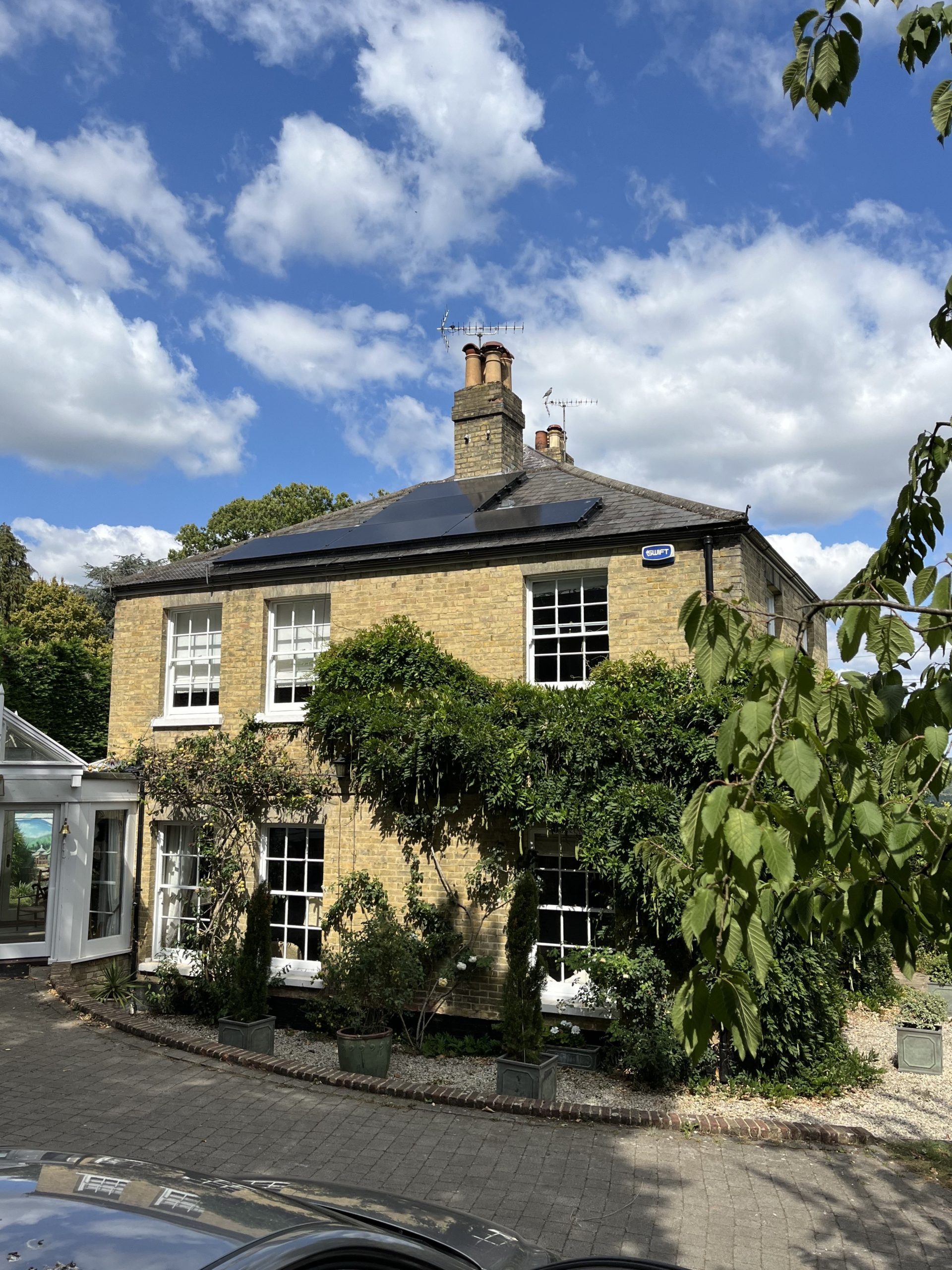
In Sevenoaks, Kent, Heritage Unlimited was appointed to advise on a solar installation at St John’s Hill, known as ‘The Firs’, a Grade II listed early 19th-century house of yellow brick with Welsh slate hipped roofs, adjacent to the Hartslands Conservation Area. The project had a difficult history. Pre-application advice from the conservation officer, received before Heritage Unlimited’s involvement, had concluded that the installation would likely result in visual and physical harm to the listed building. A subsequent application had been withdrawn.
Following our engagement, we carried out a detailed site assessment, examining the listed building, its setting, and the adjacent conservation area. Critically, our analysis of short and long-range views established that the proposed southerly roof pitches were not visible from the public realm. Working closely with the architects, OPEN Architecture, we identified a design solution that was minimally invasive and preserved the significance of the heritage assets throughout.
A comprehensive Heritage Impact Assessment was produced, grounded in Historic England’s Advice Note 18, the NPPF, and a thorough understanding of the planning process. Every aspect of the proposal was justified, directly addressing the points previously raised by the conservation officer, including the secondary nature of the roof pitches and the ability of good construction practice to avoid physical harm to the fabric.
Because the application site was the residence of a ward member, the application was referred to the Development Management Committee. Invoking paragraph 99 of Advice Note 18, that installation on roof slopes of less prominence will generally be acceptable even if visible, and noting that public views were restricted to very limited vantage points, the Chief Planning Officer concluded that the panels would conserve the character and significance of the listed building.
Outcome
Listed Building Consent granted against a continued conservation officer objection. The Chief Planning Officer concurred with the arguments made by Heritage Unlimited. Ref: 24/02037/LBCALT, 20 December 2024.
A Second Case: Paxhill Park, West Sussex
The St John’s Hill outcome was not an isolated result. At Paxhill Park in West Sussex, a Grade II listed Elizabethan stately home surrounded by three further listed structures, Heritage Unlimited were engaged to support a proposal for a ground-mounted array of 168 photovoltaic panels in the setting of the estate.
Working alongside planning consultants Smart Planning, we carried out a site visit and archival research. The proposed site, an area of open field outside the formal walled garden, bounded by native hedges and mature trees, was selected in part on heritage grounds. Topography, distance, and existing planting provided ample screening. The panels were ground-mounted at a low height of 863mm, effectively temporary in nature and leaving no lasting effect on the landscape.
Upon submission, the conservation officer objected, citing reasons that were contradicted by the submitted evidence. Heritage Unlimited produced a detailed rebuttal letter, countering each point with written and pictorial evidence. The conservation officer maintained their position and the application was refused. The Planning Inspector allowed the appeal, concurring with Heritage Unlimited’s position and evidence.
A Third Case: Former HSBC Bank, Windsor
At High Street, Windsor, the former HSBC Bank is a Grade II listed building prominently sited opposite Windsor Castle and within the Windsor Town Centre Conservation Area. Heritage Unlimited produced the Heritage Impact Assessment supporting repair, refurbishment and sustainability works including four PV panels to the rear roof slope.
The context could scarcely be more sensitive: the building sits within the setting of Windsor Castle, which carries a Scheduled Monument, a Grade I listed building, and a Grade I registered Historic Park and Garden designation. The four panels were positioned on the south-facing rear roof slope, away from the principal frontage, with slim-profile near-flush fixings to a modern replacement roof, meaning no historic fabric was affected. The conservation officer raised no heritage objection and the application was permitted (25/00405/LBC), as a straightforward delegated approval.
What This Means in Practice
The guidance is now clearer and the case law is building. High-profile installations, from York Minster to King’s College Chapel, are demonstrating that solar and heritage are not mutually exclusive. And yet the perception gap remains enormous.
For listed building owners, the lesson is straightforward: a refusal or an objection is not the end of the road. The strength of the heritage case, the quality of the visibility analysis, and the skill with which the argument is made are often the deciding factors, not the principle of whether solar belongs on historic buildings.
If you have been told that solar is not an option for your building, or a previous application has been refused or withdrawn, we would be glad to advise on whether there is a viable route forward. Both of our consultants hold the ABBE Level 3 Award in Energy Efficiency for Older and Traditional Buildings.
In this article

Get in touch
Tell us about your project. We’ll tell you what’s involved.
A short conversation is usually enough to confirm what’s needed, what it costs, and how the work is best routed. Most enquiries receive an outline approach within 24 hours.
To get a fast outline approach, share:
- The address of the property and its grading, if known
- A short description of the proposed works
- Where you are in the planning process
- Your role: owner, developer, architect, or public body